
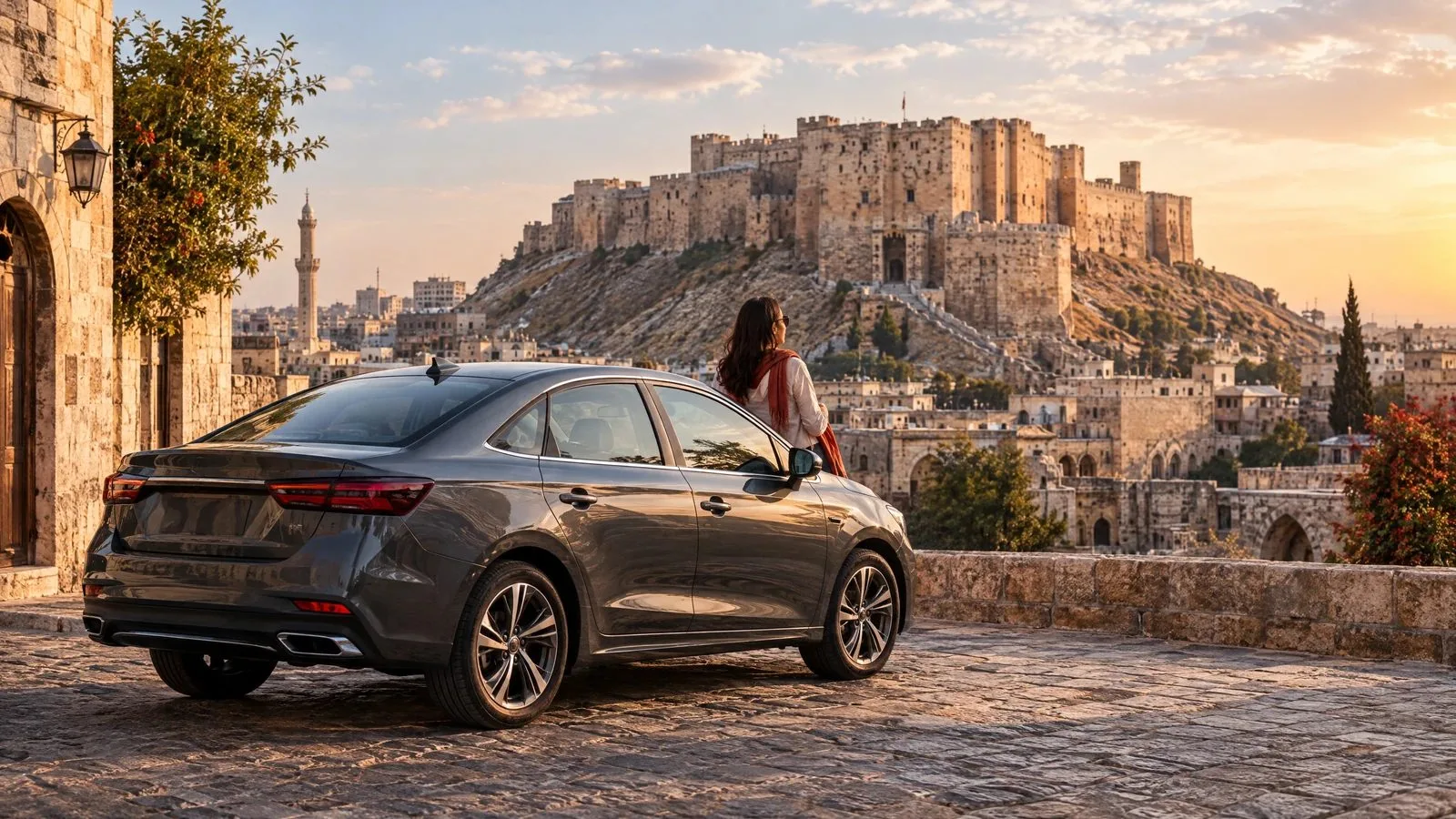
A city you cross, not a city you stroll
Aleppo is walkable in patches, and only in patches. Inside the old city, in the lanes under the citadel, you would not want a car and could not use one anyway. But the pieces a short visit is actually made of — the citadel mound, the covered souks, the Jdeideh quarter, the modern centre with its squares and its park, and the airport out to the east — are not stacked on top of one another. Aleppo is one of Syria's two great cities and it behaves like one. It sprawls, it has real traffic, and the gap between what you have just seen and what you want to see next is usually a drive rather than a walk.
That is the argument for having a car here for two days. Not because you will drive it much — you will park it more than you drive it — but because it deletes the dead time between the good hours. Without one, two days in Aleppo become a negotiation about crossing town, repeated six or seven times. With one, the two days are spent in the places themselves.
Day one, morning: the citadel
Begin at the citadel, because the old city is arranged around it and seeing it first gives you a map in your head for everything after. The mound it stands on is part natural rock and part the accumulated result of thousands of years of people living on one spot. The approach is the part everyone knows from photographs: a stone bridge carried on tall arched piers, climbing from the outer tower across the dry moat to the great gateway. The gateway is not a door but a sequence: a bent passage turning back on itself more than once, built so nothing could be run at it in a straight line. Inside are the standing and ruined pieces of a small walled town: a mosque, cisterns cut into the rock, a hall above the entrance block, the long circuit of the walls.
The citadel has taken damage in this century — from the war, and then from the earthquake of 2023 — and restoration moves around it in stages. Which parts of the circuit are open on any given day is a question for the day itself, not for an article. Give it a couple of hours anyway, for the view if nothing else: from the walls you read the plan of the old city, flat roofs in every direction, minarets and domes rising out of them, the modern city beyond.
Day one, afternoon: the covered souks
Below the citadel, running west, is the Madina souk, and the name undersells it. This is not a market square but a covered city — kilometres of vaulted stone lanes, light falling through openings cut in the ceilings, and doors that turn out to be khans, the old merchants' caravanserais, each with its courtyard and galleries. Khan al-Jumruk, Khan al-Wazir and Khan al-Sabun are the names most repeated, but half the pleasure is not knowing what a doorway leads to. The Great Mosque and its wide flagged courtyard sit at the northern edge of the same quarter.
The souks were badly damaged and have been under repair, lane by lane, for years now. Some stretches are trading; others are still bare stone and scaffolding. The proportion changes, which is a reason to walk through and see rather than look it up. The trades that belong to the city are the ones to buy from: laurel and olive oil soap, cut into cubes and stacked to age; pistachios; textiles.
Park at the edge of the old city, on one of the wider streets, and walk in. Nothing inside the souk quarter was ever designed for a vehicle.
Day one, evening: Jdeideh
Outside the old walls on their north-western side is Jdeideh, the quarter that grew up there centuries ago and became the address of Aleppo's Christian merchant families. It is the most concentrated walking in the city: narrow stone lanes, courtyard mansions with carved reception rooms around a fountain, and churches of several denominations minutes apart, the Armenian cathedral of the Forty Martyrs among them. Al-Hatab Square is the middle of it.
Some of the great houses — Beit Ghazaleh, Beit Achiqbash — have served as museums, some are under restoration, some are in private hands. Take the doorways and the carved stone as the point, and go inside whatever is open. Evening is the right time to be here, and Aleppo's kitchen is a serious argument of its own: kebab with sour cherries in season, muhammara, the pistachio sweets the city is known for.
Day two: the modern city, and what the car is really for
Give the second morning to the Aleppo that is not medieval: the clock tower at Bab al-Faraj, the long open square at Saadallah al-Jabiri, the streets of Azizieh and Sulaymaniyah, the public park. The National Museum is here too, and its entrance is worth seeing even from the street — a facade rebuilt after a temple front from Tell Halaf, colossal basalt figures standing on the backs of animals.
Then the car earns its keep. Aleppo sits at the centre of a region, and the region is where a two-day visit either opens up or stays boxed in: the limestone hills to the north-west, carrying the ruined basilica of Saint Simeon and, scattered around it, the abandoned Byzantine villages that give those hills their name. How long any of it takes, and what condition a given site is in, is worth asking locally rather than assuming from a map — but with a car parked outside, an afternoon out of the city becomes a decision you make at breakfast, not a week in advance.
To pick the car up in the city, or have it brought to you, the delivery arrangements and the charge for Aleppo are on the Aleppo car rental page. A K3 saloon is plenty for two and easier to place on a narrow street; the Sorento is what to ask for if you are six with luggage; the Creta or the Sportage sit higher and carry more, which is what a long afternoon outside the city asks for.
Arriving and leaving
If you fly in, the airport lies east of the city and the run into the centre is short by Aleppo's standards — but not one to improvise with bags at the end of a flight. Having the car waiting turns the first evening into a usable evening rather than a logistics problem, and the same applies in reverse on the last morning; delivery and collection at Aleppo airport are arranged the same way as in the city.
The shape of the two days
Morning one on the citadel, afternoon one in the souks, evening one in Jdeideh. Morning two in the modern centre, afternoon two either out of the city or back in the old lanes for what you walked past the first time. The car barely appears in that description, which is the point: it is what makes it possible in two days rather than four.