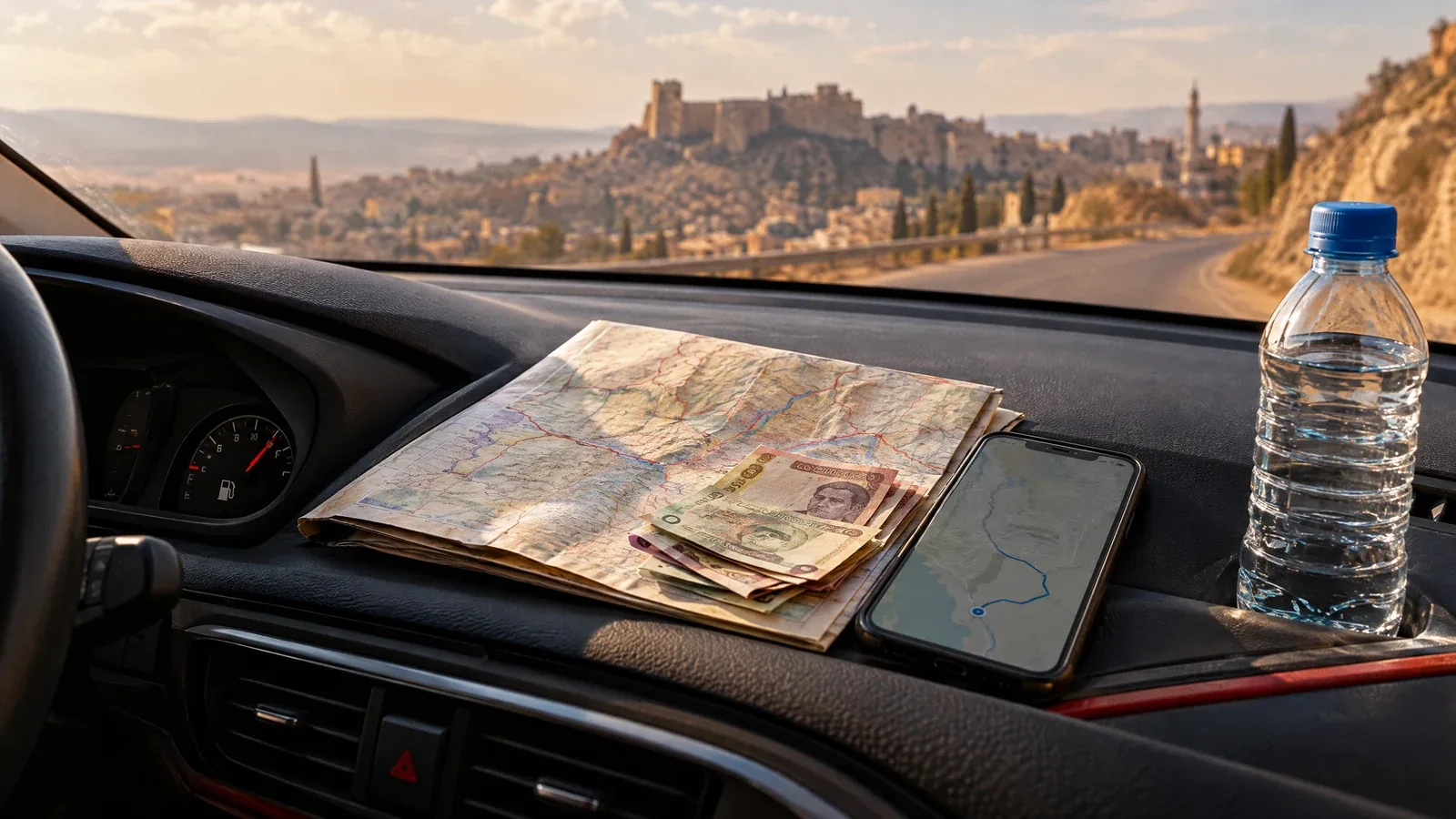
This article exists because of a particular kind of message. Somebody in Frankfurt or Michigan or Rotterdam is three months out from a trip, has a spreadsheet open, and wants to know what to put in the row marked car. Not a range. Not "contact us". A number they can budget against.
So here is the arithmetic, done out loud. Every figure below is current as of September 2026 — and that date is not decoration. A blog article is prose, not a live price feed, so when you read this, check the figure against the page it links to before you rely on it.
The daily rates
As of September 2026, by class, per day, in USD:
- Economy — 55
- Sedan — 65
- Compact SUV — 80
- Standard SUV — 100
- Seven-seat SUV — 115
Everything is quoted and collected in USD.
For most family visits the honest recommendation is the economy class or the sedan. They do the job, they are the cheapest to run, and the roads you will be on do not require anything more. A compact SUV earns its extra if you are driving out to villages on unsurfaced approaches. The seven-seat is for when the visit itself is the reason — when four of you land together and a fifth and sixth relative join for the drive to Homs — and at that point it is cheaper than two cars.
Where the monthly rate takes over
This is the calculation people from abroad most often miss, and it is the one that saves the most money.
Monthly hire starts at 1,240 USD as of September 2026, for the economy class. Set that against the daily rate and the crossover is easy to see: at 55 a day, thirty days would be 1,650. The month costs 1,240. The monthly rate has overtaken the daily rate well before you reach thirty days — at 1,240 the break-even against a 55-a-day car is around twenty-three days.
So the practical rule for a visit home is this. A two-week trip is a daily-rate trip. Fourteen days of economy at 55 is 770 USD, and the monthly rate would not help you. A trip of three weeks or more is worth pricing both ways before you book, because somewhere in the third week the month becomes the cheaper answer — and if you are already thinking "we might stay a bit longer", the monthly rate is often what makes staying longer affordable rather than what punishes it. The long-term hire page has the monthly rates by class.
Distance: 200 km a day, and what happens past it
Every hire includes 200 km per day, and beyond that it is 0.10 USD per extra kilometre, as of September 2026.
Two hundred a day sounds abstract until you put the country against it. Damascus to Homs is about 162 km. Damascus to Aleppo is about 355. Damascus out to the coast at Latakia is a little over 300.
Notice how the allowance works, because this is where people miscount. It is 200 per day of the hire, not 200 on the day you happen to drive far. On a fourteen-day hire that is 2,800 km to spend across the fortnight. A realistic family visit — a run up to Aleppo and back, a couple of days on the coast, and daily driving around Damascus in between — lands comfortably inside that. You would have to be driving the length of the country most days to go past it, and if you are, the excess is ten cents a kilometre rather than a penalty: an extra 300 km over the whole fortnight is thirty dollars.
Delivery, and why it matters more for you than for a tourist
A visitor from abroad usually wants the car at an address rather than at an office, and often at a relative's address rather than a hotel — which is exactly what delivery is for.
As of September 2026:
- Damascus — free
- Damascus International Airport — free
- Homs — 40 USD
- Hama — 40 USD
- Latakia — 50 USD
- Tartus — 50 USD
- Aleppo — 55 USD
- Aleppo Airport — 55 USD
The fee is flat and per delivery, and the current list is always on the locations page.
What this means in practice is worth spelling out. If your family is in Damascus, the car reaching you costs nothing whether it meets you at the airport at midnight or at your aunt's door in Mazraa the following afternoon. If your family is in Homs, having the car brought to their address is 40 USD — against driving 162 km down from Damascus to fetch it, which is most of a day and a chunk of the distance allowance.
And it means an arriving passenger has a real choice about the first night. You can take the car at the terminal and drive straight out, or you can arrive, sleep, and have it delivered to the house in the morning. Both are free in Damascus. People landing at two in the morning after a long day through Istanbul very often want the second, and do not realise it is on offer.
One-way, when the trip does not end where it started
Visits often run in one direction: you land in Damascus, work north through the family, and leave from somewhere else — or the last week is on the coast and there is no reason to drive back down.
One-way hire is available: collect in one city and hand the car back in another. Arrange it at booking time so the return city is written into the reservation rather than negotiated on the last morning, when you have a flight.
Two worked examples
A fortnight based in Damascus, family nearby. Economy class, 14 days at 55 = 770 USD. Delivery free both ways in Damascus. Distance: 2,800 km included, and a fortnight of city driving with one run to Homs and back uses maybe half of it. Total in the car row of the spreadsheet: 770.
Three weeks, Damascus and Aleppo, family in both. Sedan at 65 a day, 21 days = 1,365 — and at this length it is worth asking for the monthly price before booking, because three weeks is past where the arithmetic starts to turn. Car delivered free at Damascus airport on arrival; handed back in Aleppo one-way at the end. Distance: 4,200 km included against a real itinerary of perhaps 1,500. Ask us to price it both ways.
Neither example includes extras, and neither is a quotation — the booking form prices your actual dates, and cancellation is free, so you can hold a car while the rest of the trip settles.
A few things that do not cost anything
Worth knowing, because they remove the small anxieties that make people put off booking.
- Fuel is full-to-full. You get a full tank and return a full tank. No fuel charge, no service fee for the privilege; just fill up near where you are handing it back.
- Cancellation is free. Book early. Plans that depend on other people's schedules change, and nothing is lost if yours does.
- A late return is allowed. As of September 2026 you have two hours past the due time before a further day is charged. That is not a lot, but it is enough to absorb a long goodbye.
- Insurance is arranged with each hire and confirmed on the agreement when you take the car. Read that section at handover rather than assuming — it is the one part of the paperwork worth two minutes.
For completeness: the hire agreement is governed by Syrian law and the courts of Damascus. That matters to nobody on a normal trip and should be stated rather than buried.
Before the spreadsheet closes
Put the daily rate for the class you want in the car row, add the delivery fee if you are not starting in Damascus, and leave the distance allowance out of the budget entirely unless your itinerary is genuinely enormous. That is the cost.
The full fleet with current prices is the page to check the figures on before you book, and the questions page covers the rest. If you would rather ask a person, that is what the contact form is for — and a message from a desk in Germany at nine in the morning is a far better time to settle this than a kerb in Damascus at midnight.