
Three places, one small city
Tartus keeps its best things close together. The Crusader cathedral and the medieval quarter that grew up inside the fortress beside it are a few minutes' walk from the water. The island of Arwad sits offshore, visible from the corniche on any clear day. Amrit, among the most remarkable Phoenician sites anywhere on this coast, lies a short drive south of the city. Three genuinely different things, and nothing far from anything else.
What makes the day worth ordering carefully is that its middle happens on foot, on an island where cars do not exist, while both its ends want one. Amrit sits out past the edge of the city with very little around it. The harbour the boats leave from is a place you want to reach in the morning rather than at lunchtime. Get the sequence right — old town, island, then Amrit in the late light — and the whole thing fits comfortably between breakfast and dusk without anybody hurrying.
The quarter that grew into the fortress
To the Crusaders this was Tortosa, and the walled town they built beside the sea did not empty out when they lost it. People simply kept living inside it, and went on doing so. What stands today is a residential quarter built into, onto and out of medieval military stone: vaulted chambers serving as ground floors, arches that were never meant to be doorways doing duty as doorways, a stretch of keep wall standing as the back of somebody's house. It is small, it is thoroughly lived in, and an hour on foot covers it. There is nothing to tick off. The pleasure is entirely in noticing.
A few streets away stands the reason to give the quarter a whole morning rather than twenty minutes: the cathedral of Our Lady of Tortosa, begun in the twelfth century and one of the most complete Crusader churches left standing in the Levant. It is a severe thing from outside, more fortress than sanctuary at first glance, heavy-walled and narrow-windowed — and then you step in and find it far lighter and more graceful than the exterior ever promised. It has long housed the city's museum, which holds material excavated at Amrit among much else, and that is worth knowing before you drive south. Whether you find the doors open is a question the day itself answers; nobody can answer it in advance.
This is usually the point at which a visitor wishes they had given Tartus a night instead of half an afternoon. The quarter, the island and Amrit are a comfortable full day and an unhurried two, and the city is a far better base than its reputation as somewhere you pass through would suggest. Having the car with you in Tartus is what turns it from a stop into a base: the harbour, the road south to Amrit and the way out of town all start from the same parking space.
The crossing
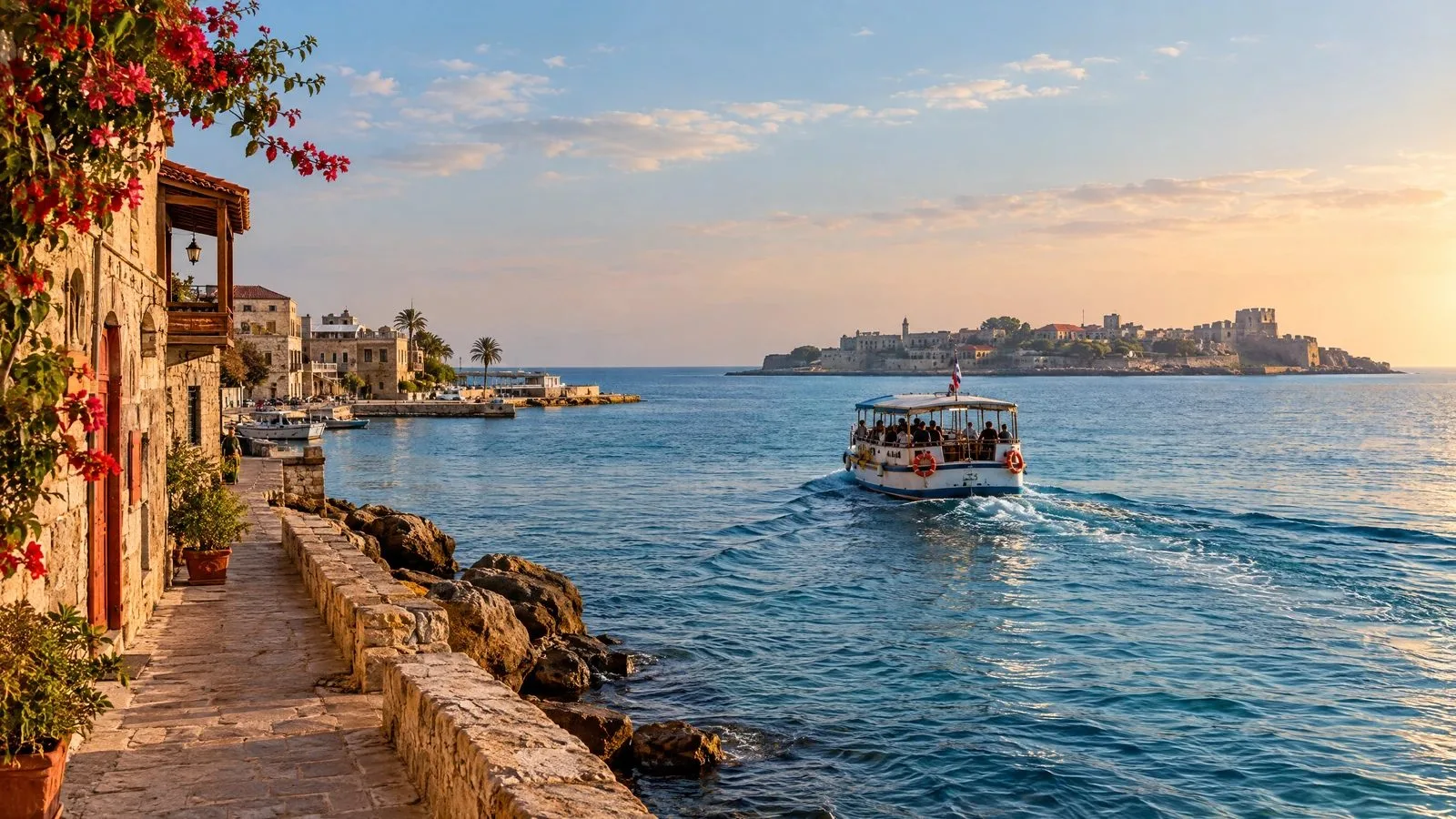
Boats for Arwad go from the harbour on the seafront — small passenger craft, open or half-covered, with people sitting along the sides. The island is close enough to read in detail from land, and the crossing is short; you have barely finished watching Tartus recede before Arwad is arriving. Boats run through the day, and more often when more people want to go, which in practice means summer and weekends.
Take a hat and something to drink. There is no shade at all on the water, and none on the open shore where the boats are built. The car stays on the Tartus side, which is less a rule than a fact of geography: there is nowhere for it to go once you land.
Arwad, which has no cars
Syria's only inhabited island is smaller than most people expect and busier than they expect too. The houses press right down to the shore, the lanes between them are narrow enough to hold their shade well into the day, and everything on it — every crate, every bag of cement, every fridge — came by boat and was carried the rest of the way by hand.
It has mattered for a very long time. As Arados it was a Phoenician maritime city-state with its own fleet and its own stretch of mainland territory, named in the ancient sources alongside Tyre and Sidon. Much later it was the last foothold the Crusaders held anywhere on this coast: the Templars kept the island after the mainland had gone, into the early fourteenth century. A fortress stands near the middle of the island, and in places the sea defences show their far older courses underneath — enormous blocks set without mortar, still doing the job they were cut for.
The living tradition worth circling the island for is boatbuilding. Wooden hulls sit on stocks along the shore, some of them still ribs and open air, and Arwad has been building boats this way for longer than anyone has been counting. Give the place a couple of hours: the fortress, a slow loop of the lanes, the boatyards, fish eaten looking back at the mainland, and then the boat home.
Amrit, south of the city
Amrit — ancient Marathus — is the part of the day that most rewards having a car, because it stands on its own in open ground beyond the edge of the city, and the hour you arrive and the hour you leave are entirely yours to choose.
Three things there are unlike anything else on this coast. The maabed, the temple, is a broad court cut down into the living rock with a small shrine standing on a podium at its centre; the court was once filled with water fed from a spring, so that the shrine stood on an island of its own. The meghazil — "the spindles" — are funerary towers raised over rock-cut burial chambers, tapering monuments that have been landmarks in these fields for well over two thousand years. And there is a long track cut straight into the rock, generally described as a stadium, which is a strange and very quiet thing to walk the length of.
Late afternoon is when to be there. The stone warms, the shadows stretch across the cut court, and the odds are good that you will have most of it to yourself.
Where the car goes next
Tartus is the last large city at the southern end of the Syrian coast, and few travellers stop with it. Most either arrive from the north or leave that way, and Latakia is where the coast changes character: a larger, louder city with the mountains standing directly behind it. If your trip continues in that direction, the question that settles the rest of your planning is which end you start from. Beginning with the car already with you in Latakia sets you up to work slowly southwards and finish here; beginning in Tartus puts Arwad and Amrit on your first day rather than your last.
Either way the day itself holds its shape. Arrive, park, cross, come back, drive south, and be standing at Amrit while the light is still good.