
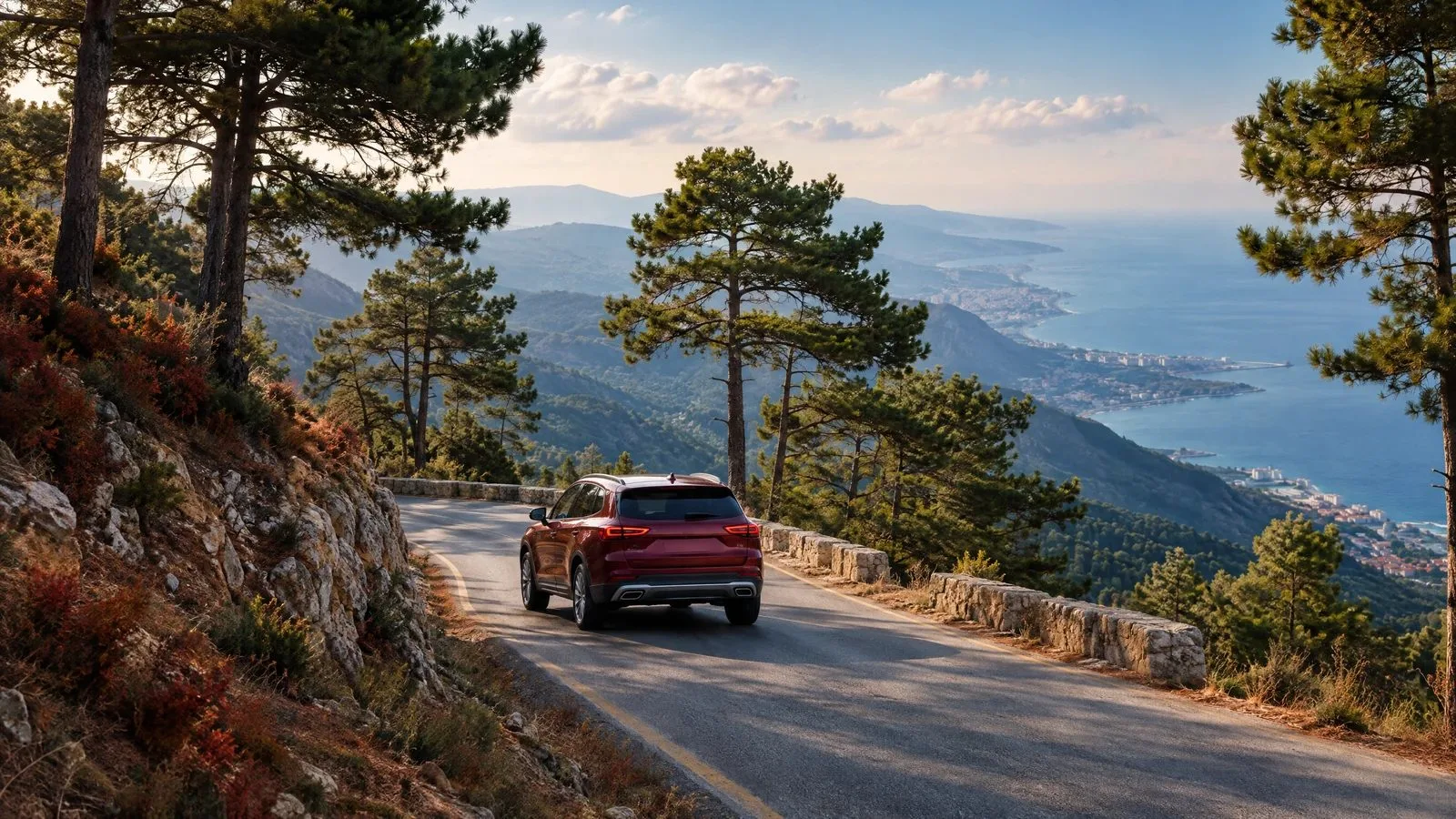
The coast is narrower than people expect. From the water in Latakia you can see the mountains, and they are not a backdrop — they are the next thing you drive through. The citrus and olive plain that carries the coastal towns is a thin strip, and behind it the coastal range, Jabal al-Ansariyah, runs most of the length of Syria's western edge like a wall. Getting into it does not take an expedition. It takes a turn inland after breakfast.
That is the argument for this drive, and it is a simple one. Down at sea level in high summer the heat is heavy and wet and does not let go after dark. Up in the pines it is dry, it smells of resin, and by evening you are looking for a jacket. Same day, same car, same tank of fuel. You have simply gone up.
Slunfeh, and the road that gets you there
Ask anyone on the coast where they go when the summer becomes unbearable and you will get one name: Slunfeh. It sits high on the range east of Latakia in pine forest, and much of the town exists because of exactly that — a summer place, busy in the hot months, quiet and genuinely cold outside them.
The road up is at least half the reason to go. It leaves the plain through villages and terraces, past olives and tobacco, and then settles into a long series of switchbacks that climb steadily for a long time. The vegetation changes as you gain height, and that is what people remember: fig and olive low down, then walnut and apple, then pine standing close on both sides of the road. Cloud sits on this ridge often, so you can start in bright coastal glare, finish the climb inside a grey nothing with the trees appearing a few metres at a time, and then come out above it.
Do not treat the summit as the destination. The pleasure of these roads is the stopping: a shoulder wide enough to pull onto, the engine off, the temperature difference on your arms, and a view back down the valleys you spent the last hour in. That is also the argument for the car. A seat on a scheduled vehicle takes you between towns; it does not stop where the view is. If the coast is your base, rent a car in Latakia and treat the mountains as a series of half-days rather than one long excursion.
The castle between two ravines
East of Latakia, in the same mountains near al-Haffah, stands Qal'at Salah ad-Din — Saladin's Castle. It runs along a rock spur with deep wooded gorges falling away on either side, and its most famous feature is not what its builders put up but what they took away: a channel cut straight down through the rock across the neck of the spur, with a single tall needle of stone left standing in the middle of it to carry the bridge.
UNESCO lists it as World Heritage alongside Krak des Chevaliers, and what makes it the different one of the pair is the setting. It is in forest, on a ridge, with wooded valleys underneath, and it is close enough to Latakia to be a morning rather than a day. If you are heading up into these mountains anyway, it folds into the same day without much effort.
North to Kassab and the pine country
The other direction is north. The road follows the coast, then turns inland and climbs to Kassab, in the far north of Latakia governorate, close to the Turkish border. It is a historically Armenian town, its houses spread over the slopes with red roofs among some of the densest pine and oak forest in the country. Above it stands Jabal al-Aqraa, the highest peak of the coastal range — Mount Casius to the ancient world.
What is worth planning for on this side is the contrast. Below Kassab, back toward the sea, is Ras al-Bassit, where the beach is dark: grey-black sand, unlike anything on the rest of the coast. Forest air and a black-sand shore in the same afternoon is a combination this corner of the country has more or less to itself.
The same range, going south
The mountains do not stop at a governorate line. The range continues south, and the hill country behind Tartus has its own version of everything described above, with more of the sea in view.
Safita is the town people mean here. It is built up a hillside around a Crusader keep the Templars left — Chastel Blanc, the White Tower — which still stands in the middle of the town with houses packed around its base rather than fenced off on a hill. Further north and west, above Baniyas, Qal'at al-Marqab sits on a dark basalt ridge looking down at the coast, which is a very different kind of view from a castle in a forest.
Driving the hills from Latakia down to Tartus, instead of taking the coast road, turns a short transfer into the best part of a day. The southern coast works just as well as a starting point, too: we deliver to Tartus as well as to Latakia, so you can begin with a car in Tartus and drive the range northwards instead.
What these roads ask of the car, and of you
They are ordinary paved roads. What they are not is wide. Expect steep gradients held for a long time, tight bends you cannot see around, and slow lorries you will sit behind until the road gives you somewhere sensible to pass. Use a low gear on the way down rather than riding the brakes the whole descent — that single habit is the difference between a relaxed drop back to the coast and a smell of hot brake pads at the bottom. Fog is normal on the ridge and it arrives quickly: dipped beams rather than high, and slow down instead of trying to see further.
Any of our cars will do this route. A saloon like the Kia K3 climbs it perfectly well, and this is not terrain that needs anything special. That said, the higher seating of a Hyundai Creta or Kia Sportage makes the bends more comfortable and lets you see over walls and hedges, and the seven-seat Kia Sorento is the answer if the day is a family one. Fill the tank on the coast before you start climbing, rather than looking for a pump halfway up a ridge.
Shaping the day
Go up in the morning and come down in the afternoon: the light is better on the way down, and the cloud tends to be doing something more interesting by then. Take a layer even in August. Eat late rather than early, because the stops worth making are not the ones you can plan.
And treat the mountains and the shore as one trip rather than two. It is the reason the coast is worth a car at all: the sea in the morning, forest in the afternoon, and the whole decision made after breakfast rather than a week in advance.