
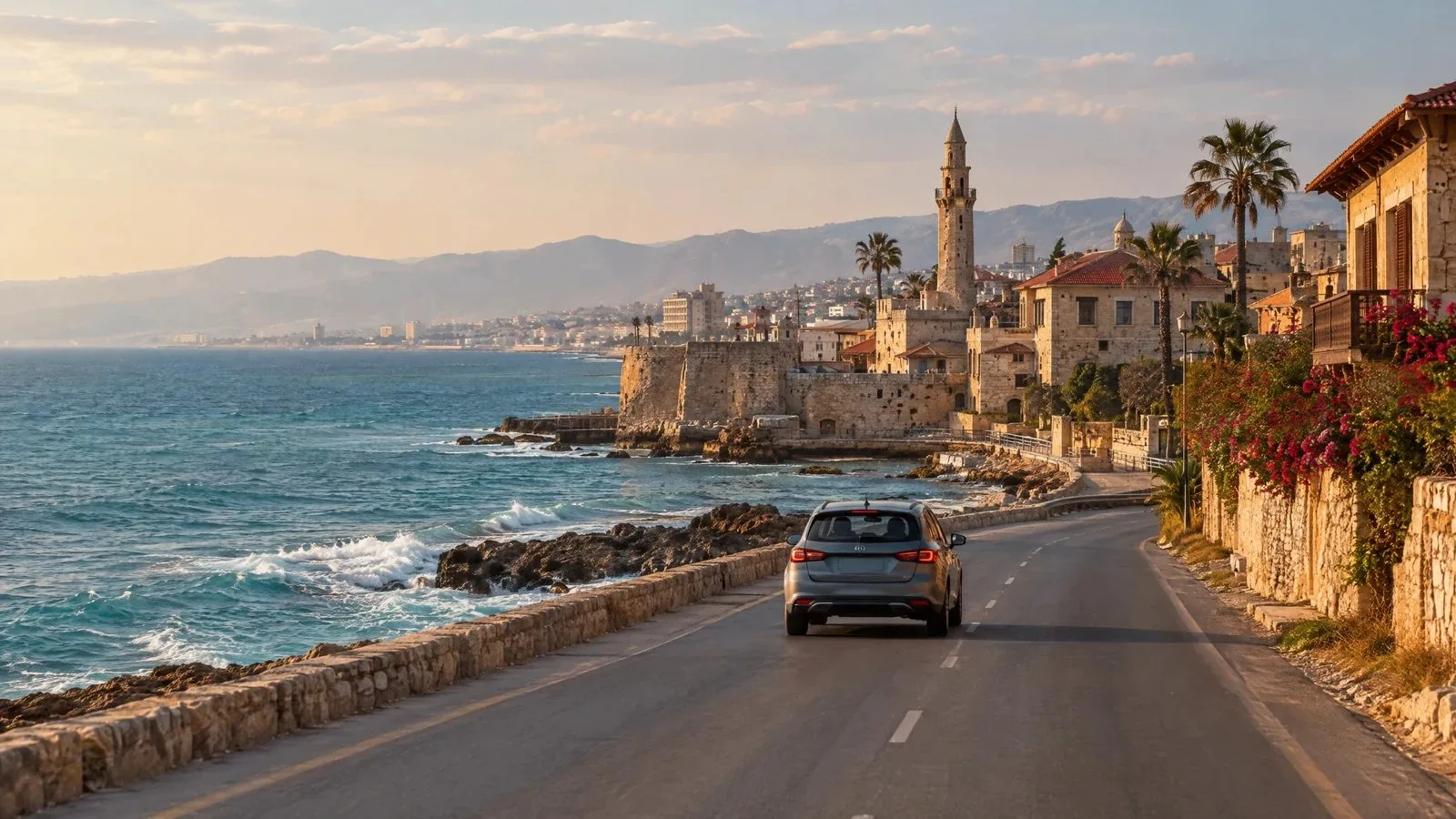
The Syrian coast is short. That is the first thing to understand about it, and the thing that makes it such good driving. From the northern edge of Latakia to the southern edge of Tartus is roughly 85 to 90 kilometres of road, most of it within sight of the sea or a few minutes from it. You can drive the whole coast in a morning. What you cannot do is see it in a morning, because the interesting part is everything you stop for on the way.
The road between Latakia and Tartus
The coastal highway links the two port cities directly, and the drive takes around an hour and a half in normal conditions — not because the distance is long, but because the road passes through towns rather than around all of them, and because you will slow down for the sea.
The order of things going south is easy to hold in your head. Jableh sits about 25 kilometres below Latakia, with a Roman amphitheatre a short walk from the shore. Banias is roughly 25 kilometres further on. After that the coastal plain narrows, the mountains push closer to the water, and you are in Tartus before you have quite finished the playlist.
Coming the other way is the same drive in reverse, with better light. Late afternoon on the northbound run puts the sun over the water on your left for most of the way.
Both ends of this road are places we deliver to, which matters more than it sounds. You do not have to treat one city as the base and the other as a day trip. Pick the car up in one and hand it back in the other if that suits the shape of your week — one-way rental between cities is something we do.
Arwad, and why you should plan a boat into the day
Arwad lies about three kilometres off Tartus, and it is the only island Syria has. Small boats cross from the Tartus waterfront and the trip takes something in the range of twenty to thirty minutes depending on the sea.
The island is worth the crossing for a reason that has nothing to do with sights: there are no cars on it. The lanes are too narrow for them. You spend an hour or two walking between stone houses and boat workshops, eat fish looking back at the mainland, and return. Plan it as an afternoon rather than a stop, and park on the Tartus side without stress — the car is not coming with you.
This is the one part of the coast where a car is genuinely no use, and it is the part that makes having a car worthwhile. Getting to the boat, and getting away from the boat afterwards on your own schedule, is the whole difference.
Down to Homs, or up from it
Tartus to Homs is about 95 kilometres and takes roughly an hour and a half. The road leaves the coast and climbs east through the gap in the mountains — the only easy break in the coastal range, which is exactly why the crusader castles were built to watch it. If you have half a day, the castle country in the hills west of Homs is on this line, and it is the sort of detour that is trivial with a car and close to impossible without one.
That road also means the coast is not a separate holiday. Homs sits on the way to and from Damascus and Aleppo, so a coastal loop is a real option rather than an out-and-back. From Damascus to Latakia is around 330 kilometres, four to five hours, and you would come back through Homs anyway. You can start with a car rental in Latakia, work south, and finish with a car in Homs — or the reverse.
A full day on the coast, honestly described
Here is what a day actually looks like when it works. Leave Latakia after breakfast. Stop in Jableh for the amphitheatre and coffee. Take the road slowly through Banias, eat lunch somewhere you did not plan. Reach Tartus in the early afternoon, leave the car, cross to Arwad, come back at dusk and walk the Tartus corniche. That day contains three towns, one island and a lot of sea, and it is not tiring. On any other transport it is two days and a great deal of waiting.
Why the car, specifically
Shared taxis run this coast and they run it well between the main cities. What they do not do is stop at the Roman theatre, wait while you look at a beach, or take the mountain road back instead of the highway. The coast rewards deviation, and deviation is exactly what a scheduled seat cannot give you.
Practical points before you book
- Minimum driver age is 23. We accept driving licences from every country, foreign licences included, and there is no nationality requirement.
- Fuel comes to you full and comes back full.
- The kilometre allowance is per car and is stated on that car's own page — worth a look if you are planning the full coast plus Homs.
- Cancellation is free.
- Delivery to Damascus and Damascus Airport is free. Delivery to Latakia, Tartus, Homs, Hama, Aleppo and Aleppo Airport is 50 dollars.
- There is no security deposit, on any car. Nothing is held in cash, nothing on a card, and no signed undertaking is asked for.
Pick your city and start there: rent a car in Tartus if the island is the point of the trip, or browse all our locations if you have not decided which end of the coast to begin from.