
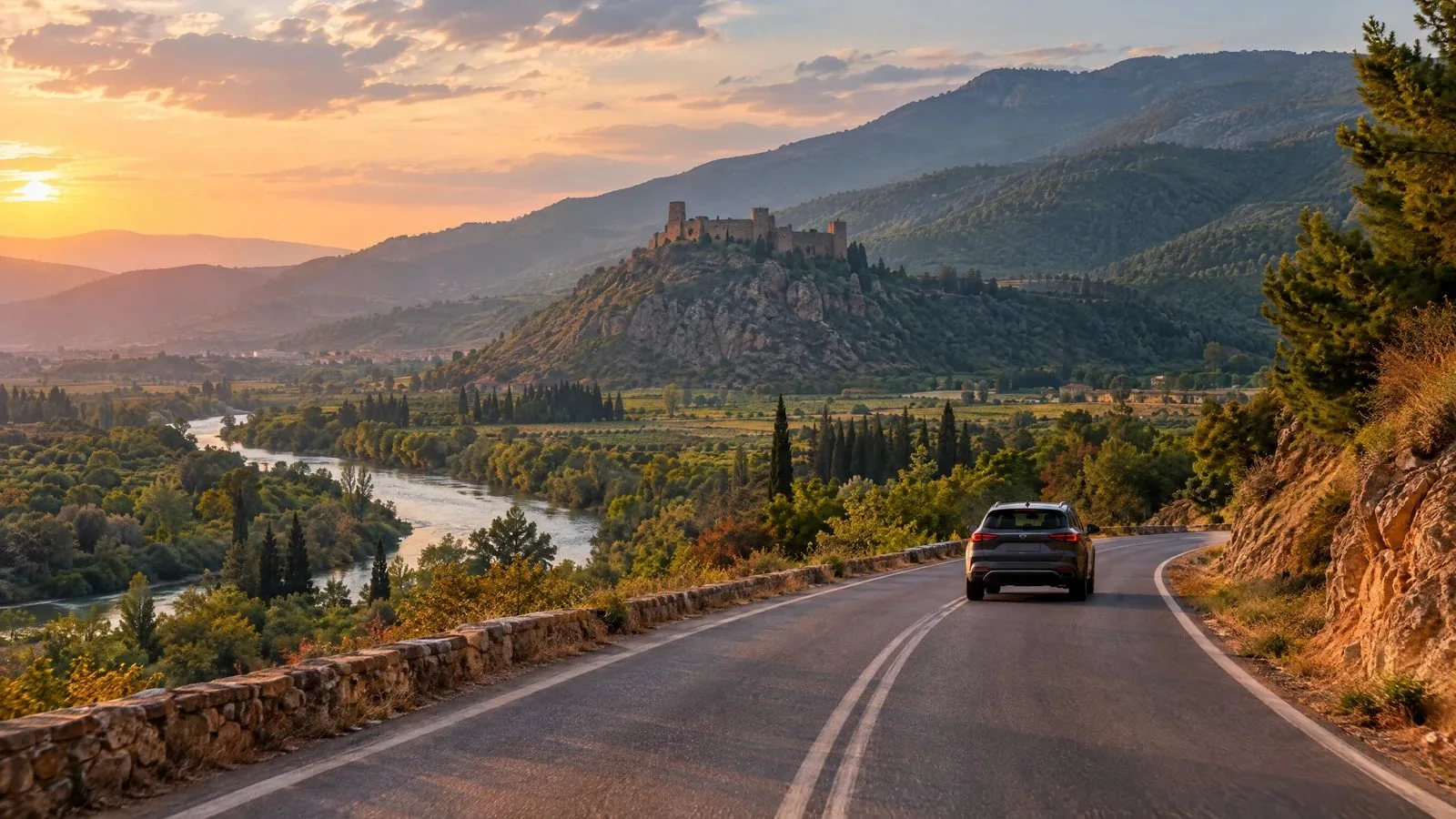
There is a stretch of country between Hama and the sea that most travellers cross without noticing they crossed anything. They take the quick way, arrive, and wonder afterwards what those mountains were. The slower way — west out of Hama along the edge of the Orontes valley, up to Masyaf where the plain runs out against a wall of rock, then over the coastal range and down to the water — is one of the best half-days of driving anywhere in Syria. It is also the kind of route that only really works with your own car, because almost all of it is the part between the places.
Out of Hama, and a river running the wrong way
The city lets go of you quickly. A few minutes past the western edge you are in irrigated farmland: olive and pistachio on the drier rises, cotton and maize on the flat where the water reaches, canals cutting the fields into long rectangles. The river somewhere off to your right is the Orontes — al-Asi, the rebel. The name is usually explained by the direction it takes. Nearly every other river in this part of the world runs south or west and is done with it; this one insists on going north, up the long trough between the coastal mountains and the inland hills, before it finally turns for the Mediterranean.
Whether or not that is where the name truly comes from, it is the right way to hold the geography in your head. The whole drive west from Hama is organised by that trough: the flatness underfoot, the water, and the ridge on the far side getting steadily, unmistakably closer.
Shayzar, above the water
Before Masyaf there is a stop worth making. The castle of Shayzar stands on a long rocky spur above the Orontes, north-west of Hama; it lies north of the direct road to Masyaf and is worth the detour. The approach is half the pleasure — the road comes at it from below, and the ridge simply stands up out of the fields with a fortress along its spine, narrow because the rock allowed nothing else.
In the twelfth century this was the seat of the Banu Munqidh, an Arab family whose most famous son, Usama ibn Munqidh, wrote a book of recollections about the life he led here: hunting, quarrels, doctors, lions, Franks, old age. It is one of the liveliest first-person voices to survive from that century. Read a few pages before you come and the ruin stops being a ruin; it becomes somebody's house with a river underneath it. A great earthquake wrecked Shayzar in the same century, and much of what you see went up afterwards along the same stubborn line of rock.
Masyaf, where the plain stops
Masyaf is a working town with a castle in it, not a monument with a town attached. You come in through ordinary streets and the outcrop is suddenly there in the middle of everything, low-looking from a distance and a good deal bigger once you are standing at its foot.
Its fame is twelfth-century. This was the principal Syrian stronghold of the Nizari Ismailis, and the base of Rashid al-Din Sinan, the figure European chroniclers of the Crusades wrapped in legend as the Old Man of the Mountain. The fortress was the subject of a careful conservation programme earlier this century, and what survives is the sort of castle you move through rather than look at from outside: passages cut into the rock, cisterns, chambers that use the outcrop itself as a wall, stairs that turn where the stone turns.
The view is the real argument for the place. From the upper level you look east across everything you have just driven — the plain running flat and hazy back toward Hama — and west into the first creases of the mountains, and the choice of this particular rock stops being a historical fact and becomes an obvious one.
The climb
West of Masyaf the road gives up pretending to be flat. It climbs in long bends, and the country rearranges itself as you gain height. Oak scrub gives way to pine. Olive terraces are cut into slopes at angles that look like an argument with gravity. Villages sit along the contours, houses stepped down the slope, roofs close enough below to see the washing on them.
Drive this one attentively. The bends are genuine bends and you cannot see round most of them, and you will share it with lorries grinding up in low gear and, now and then, a flock crossing at its own pace. None of it is difficult; all of it rewards a slower speed than you would use on the plain. The air cools noticeably as you rise, which on a summer afternoon is worth the detour by itself. Near the top the whole valley opens up behind you, and it is worth pulling over safely to look.
Down to the sea
There is more than one way off the mountain. You can carry on west over the range and drop toward the coast south of Latakia, then run north along the shore; or you can drop back down from Masyaf, cross the Ghab — the wide, flat, heavily farmed floor of the Orontes valley — and reach the coast further north, where the river cuts through the hills near Jisr al-Shughur. The first is the more dramatic climb. The second gives you the Ghab, which is a landscape in its own right: enormous, green in the irrigated months, ringed by mountains on both sides.
Either way the descent has its moment — a bend where the pale band at the bottom of the view stops being haze and becomes the sea. Before long you are in a different country: red-tiled roofs, citrus, damp warm air, the coast road. Latakia is the natural end of the day, and the route makes far more sense as a line drawn to the water than as a there-and-back.
The car, and the day
Any of the saloons will do this route in comfort; none of it demands a particular kind of vehicle. The mountain section is simply more pleasant in something that sits a little higher, so given the choice take the Creta or the Sportage, or the Sorento if there are more than four of you with luggage.
Fill the tank before you leave Hama rather than counting on a station appearing at the right moment on the climb, and treat this as a daylight drive: you want light for the bends, and for the view you came for. Start early, allow a full day if you mean to walk both castles properly, and do not plan on making up time later — nothing about this road is fast, and that is the point of it.
Starting from Hama puts you at the eastern end of the route with the whole of it ahead of you. Tab delivers to Hama for forty dollars and to Latakia for fifty, and free in Damascus and at Damascus airport if the trip begins there instead.