
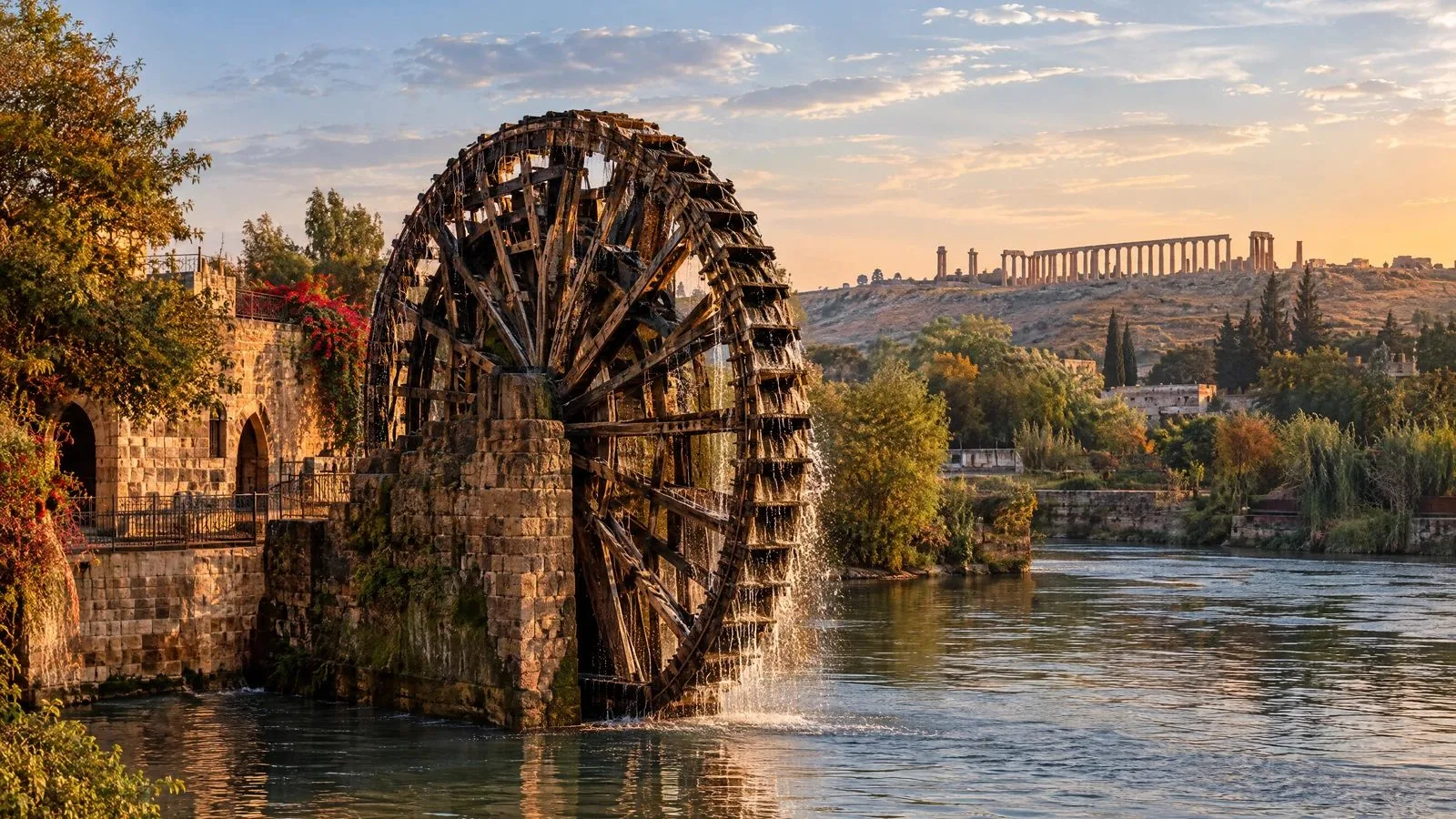
Most cities ask you to look at something. Hama asks you to listen first. Somewhere between the bridge and the gardens a sound starts up that you will not place: a deep, unhurried groan, wooden and enormous, repeating every few seconds like something breathing in its sleep. That is a noria turning, and Hama has kept more of them than any other city.
This is a guide to Hama and what is within reach of it: the wheels on the Orontes, and Apamea an hour downstream, where a colonnaded street runs along a ridge for kilometres. It is also an argument that Hama, more than almost any other Syrian city, is worth arriving in with your own car.
What a noria actually is
A noria is a waterwheel that lifts water without being driven by anything but the river. Boxes fixed around the rim fill at the bottom of the turn and tip at the top, spilling into a stone aqueduct that carries the water away at roof height to gardens, mosques and fountains sitting above the level of the stream. No motor, no fuel, no attendant: the Orontes pushes the paddles, and a machine several storeys tall goes round all day.
The sound is the part nobody warns you about. Wet timber turning in a wet timber bearing, at that scale, produces a note you feel as much as hear, and it carries several streets back from the water. Hama grew up inside it; visitors tend to stop mid-sentence.
These are not ornaments. The norias are the working end of an irrigation technology that fed the Orontes valley for centuries, and the wheels standing today are medieval in origin, rebuilt many times over — seventeen of them conserved, and described as water-raising machines of medieval origin on the Orontes — a noria is a machine, and a machine left alone rots. The largest, al-Mohammadiyya, once raised water into an aqueduct serving the city's great mosque; the pair called the Ja'bariyyat stand side by side on the bank.
Seeing them properly
The wheels are strung out along the river through the middle of town rather than gathered into one site, which is the best thing about them. You walk the riverside gardens from one to the next while the city goes about its business around you: tea, families, the water, that noise. An unhurried hour covers the central stretch, and late afternoon is the light you want, when the spray off the wheels catches the sun.
One honest caveat. Whether a given wheel turns on the day you arrive depends on the level of the Orontes, and the river rises and falls through the year. In high water they run; when the flow drops, some stand still. Nobody can promise you a particular wheel in motion on a particular afternoon.
A few minutes from the water stands the Azem Palace, an eighteenth-century Ottoman governor's house of courtyards and banded black-and-white stone, built to stay cool through a Hama July. The old quarters are small enough that you will not need a map.
Apamea, an hour downstream
Then the reason to have kept the car. The Orontes runs north out of Hama, and north-west of the city the ground rises to a long plateau. Along its spine runs one of the longest colonnaded streets of the Roman world. Apamea was founded by Seleucus I and named for his wife Apama; the Seleucid army kept its cavalry and its war elephants here, and under Rome it grew into a major provincial city. What survives, and what you have come for, is the street.
The great colonnade runs for kilometres, straight, with re-erected columns standing in file along both sides and the old paving between them. Many of the shafts are cut with a spiral fluting that twists as it climbs — unusual, and strange to the eye when you walk the line of them. The street crosses open country, and the site is far larger than the photographs suggest. To one side the Ghab plain drops away, flat and green and farmed; to the other, hills. The ridge is exposed and there is almost no shade, so take water and a hat.
At the southern end, on its mound, sits Qalaat al-Mudiq — a village living inside old walls, with a large Ottoman khan below it.
Go knowing what happened here. Apamea was looted on an industrial scale during the war years, and satellite imagery showed the ground around the colonnade pitted with thousands of illegal digging holes; much of what lay under the surface is gone. The colonnade stands, the ridge is still the ridge, and the walk is still one of the most extraordinary hours in the country — but go to see Apamea as it is, not as a photograph from twenty years ago.
The way out runs on main road for most of the distance and on smaller country roads at the end, through villages and irrigated fields with the Orontes never far off. If you have appetite for one more stop, the castle mound of Shayzar sits above the river roughly on the way.
Why Hama rewards a car more than most
In Damascus a car is something you park and forget for the first two days. In Aleppo the old city is a walking city. Hama inverts that: the city itself is small and easily read, small enough that a car is never a burden inside it, and everything that makes the region worth the journey lies twenty minutes to an hour outside it, spread across a river valley with no rail line and no timetable to hold you together. Apamea, the Ghab, the castles above the Orontes — these are places you reach by deciding to, in the morning, with a full tank.
The city's other advantage is where it sits: on the M5, roughly midway up the country, less than an hour north of Homs and a straightforward run south of Aleppo. It costs almost nothing to build into a longer trip. If you are already based further south, renting a car in Homs puts Hama within an easy half-day and gives you the wheels and Apamea without moving hotels.
Getting the car to Hama
If Hama is your starting point rather than a stop, we deliver there for a flat fee — arrange it from the car rental in Hama page — while delivery inside Damascus and at Damascus airport is free. The branches themselves are in Damascus, at Damascus airport and in Aleppo, so Hama works as a stage on a longer route as easily as a place to begin.
On which car: the M5 legs and the run to Apamea are ordinary tarmac and a saloon handles both, but the smaller roads at the end of the drive are more comfortable in something that sits higher — the Creta or the Sportage. For a family, the seven-seat Sorento exists for exactly this kind of day. Check the kilometre allowance — Apamea and back, plus a wander through the Ghab, adds up faster than people expect, and 200 km a day are included with extra kilometres at $0.10. Cancellation is free, and there is no deposit on any car to factor in.