
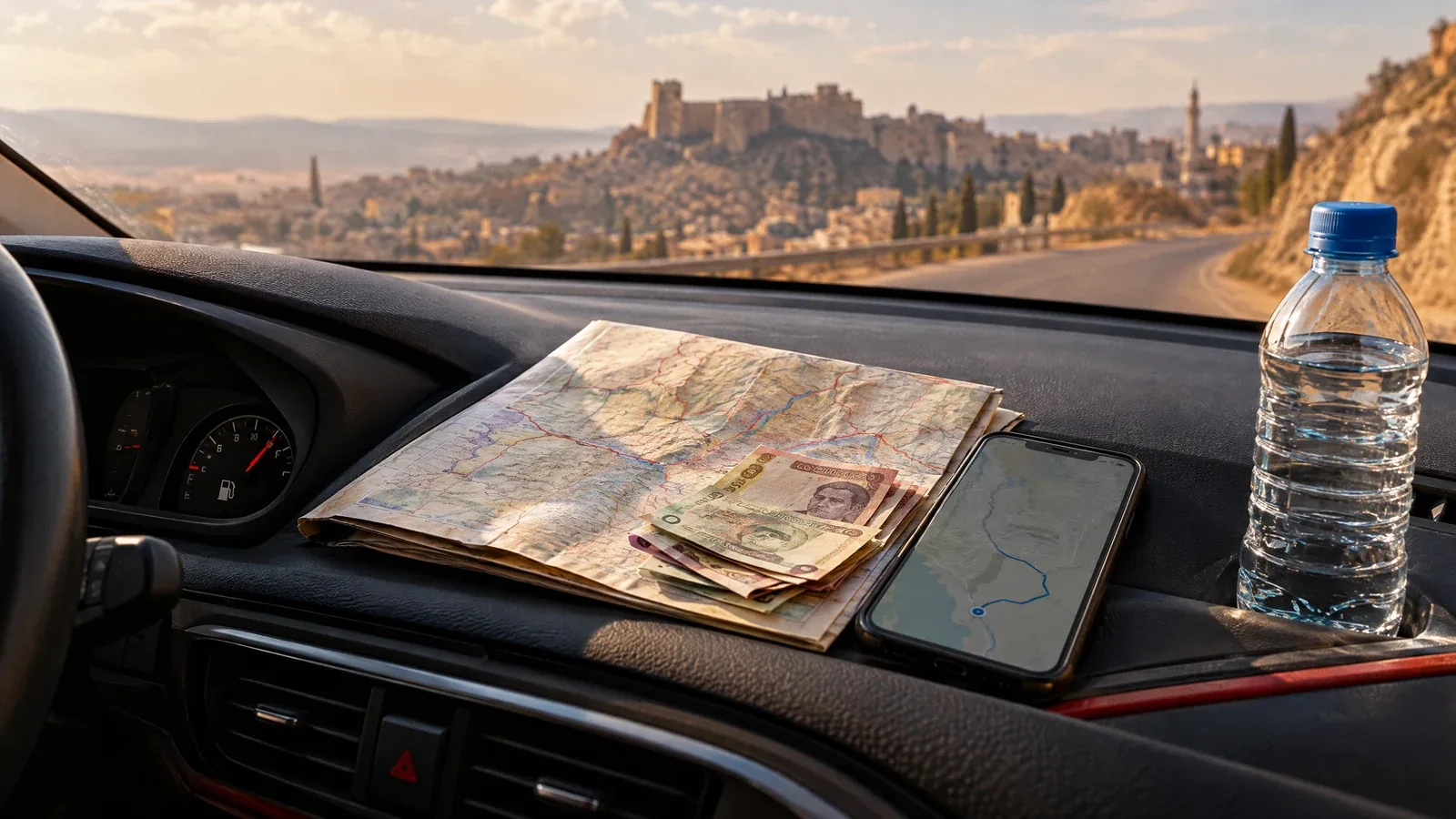
The scenic half of a Syrian road trip writes itself: the citadel on its mound, the water wheels turning on the river, the sea arriving at the bottom of a mountain descent. The other half is duller and decides everything — where you fill up, what you pay with, whether your phone knows the road, and where the car sits while you walk into a quarter that was laid out long before cars existed. Get the dull half right and the scenic half looks after itself.
Fuel is a planning unit, not an errand
The single habit that changes a Syrian driving day is this: stop treating fuel as something you deal with when the gauge complains, and start treating the tank as the unit your day is measured in. Fill in the town you wake up in. Fill again in the last town of any size before a long stretch, even if you are only half down. A half tank in a city is worth more than a full tank you have to go looking for.
Plan the fill into the schedule rather than around it: if you have somewhere to be in the evening, put the fuel stop in the morning, when you are not counting minutes. Expect to be served at the pump rather than serving yourself, and say out loud which fuel your car takes before the nozzle goes in — learn that when you collect the car, not at the first station. It takes two seconds and it is the cheapest insurance in this article.
If your trip begins at an airport rather than in a city, the arrival hour is when all of this gets done: money, a phone connection, a full tank, before the first real drive rather than an hour into it. That is especially true if you are picking the car up at Aleppo airport and heading straight out to the north or the west, because the first hour of the trip is the one where you have the least idea what is around you.
Carry cash, and split it up
Syria runs on cash to a degree that surprises visitors who have not carried a banknote in years. Assume a card will not be taken — at a fuel station, at a roadside stop, in a village shop, at a small museum gate — and treat any place that does take one as a bonus. That single assumption removes most of the trouble people run into.
The practical consequence is that you budget cash for the whole route, not for the next stop. Sort money out in a city before you set off for smaller towns, and get small notes when you do. Small notes are what daily life is conducted in: a coffee, a bag of fruit from a seller on the pavement, a man who watches your car for an hour, the boat across to an island.
Split what you carry. Keep the day's spending money where you can reach it without opening anything, and the rest somewhere else entirely. Do not leave money in the car — not here, not anywhere — and do not leave it in a bag you then leave in the car, which is the version of the mistake people actually make.
Signal, maps and the offline habit
Get a local number if you can: you can call ahead, you can be called back, and you are not rationing a roaming allowance every time you check where you are.
Coverage along the main highways is usually workable and gets thinner as you climb. Mountain roads and valley floors are where it disappears, and those are exactly the roads where you most want a map. So build the offline habit before you leave the city: download the map area for the whole route while you are still on good signal, in whichever app you use — Google Maps and Organic Maps both offer it — and drop a pin on the destination rather than trusting yourself to search for it later.
Two more small things. Write down, on paper or in a note that works offline, the phone number of whoever you are meeting and of the rental office, because a phone with no data can still make a call. And be sceptical of a route that offers to shave a few minutes off the day by leaving the highway. On an unfamiliar road in an unfamiliar country, the boring highway is the fast road.
Parking, and the rule about old quarters
The rule is simple and it holds everywhere in Syria: park at the edge and walk in. Old quarters were built to the width of a loaded donkey, and no amount of confidence turns a seven-seater into something that fits. Find the last wide street, leave the car there, and go the rest of the way on foot. You will see more anyway.
This is the difference between an enjoyable morning and a stressful one in Hama, where the pleasure of the norias is walking the riverside between them rather than hunting for a gap beside one. It applies just as much on the coast: cars stay on the mainland in Tartus and you cross to Arwad by boat, so the parking decision is made once, before you step onto the water, and then forgotten for the rest of the day.
Wherever you leave it: fold the mirrors on a narrow street, take everything visible off the seats, and photograph the nearest street sign or shopfront before you walk away. Every driver who has ever hunted for their own car in a grid of similar streets has learned this the hard way.
What lives in the car
Water, more than you think you need, refilled at every stop rather than when it runs out. A car charger with two ports, because one phone is navigating and the other is taking photographs, and a power bank behind it. A cloth, because dust on a windscreen at sunset is a real visibility problem. Something to eat, so hunger never dictates where you stop.
A layer of clothing, too. The mountains are cooler than the coast and the evening is cooler than both, and people who packed for the beach regret it once the road climbs. Finally, before the first long day, find out what the car carries for a puncture and where it is kept, and save the rental company's number so it works offline. What happens next in a breakdown is a matter for your rental agreement, not for guesswork on a hard shoulder.
Plan the day backwards
Decide where the day ends before you decide what it contains. Work back from that: the last unfamiliar stretch is much easier in daylight, addresses are easier to find in daylight, and parking somewhere new is easier in daylight. Everything above — fuel, cash, the offline map, the walk-in-from-the-edge rule — is one instruction wearing different clothes. Do the boring parts early, while they are cheap, and spend the rest of the day looking out of the window.