
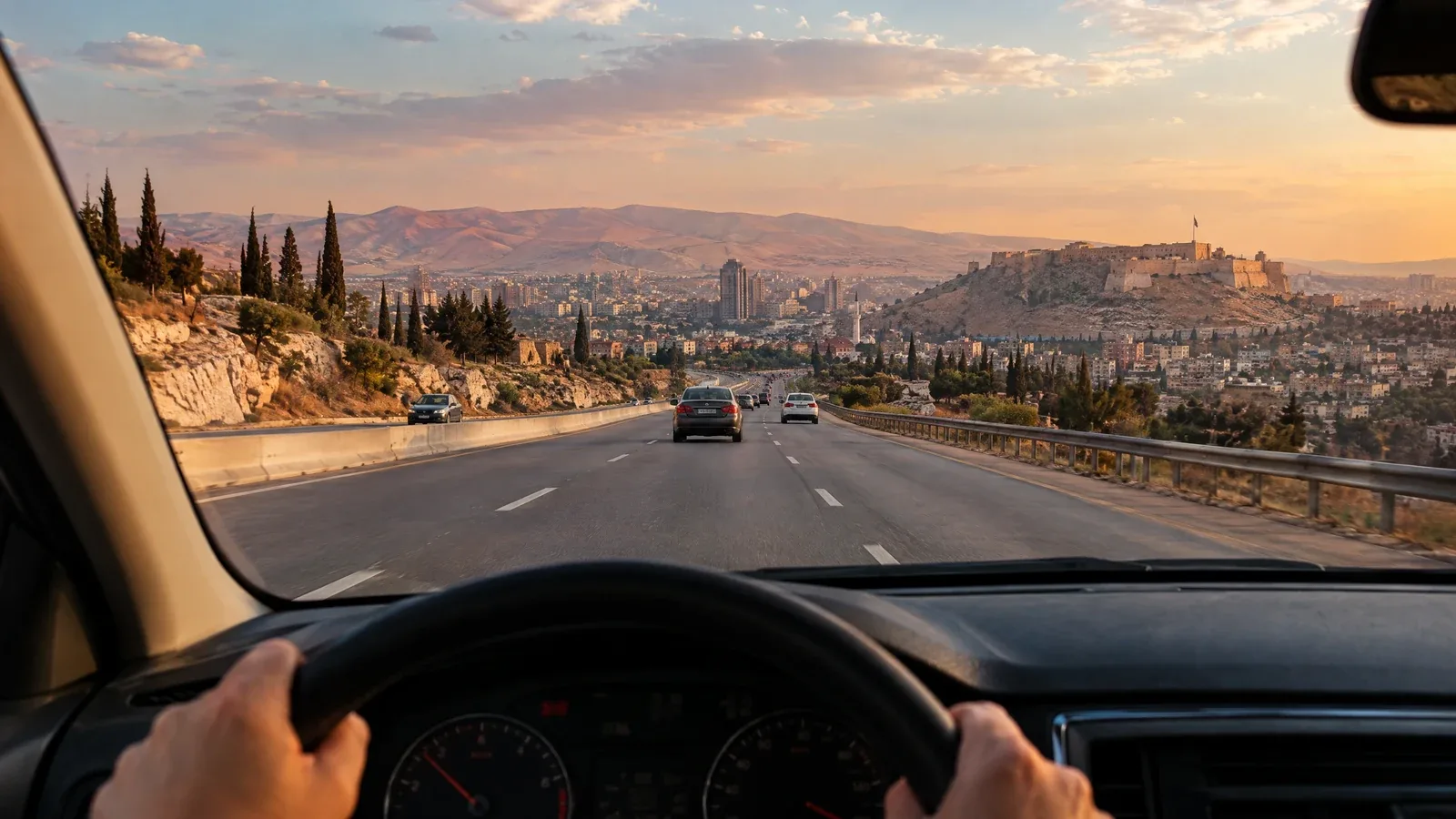
Most people who ask us about driving in Syria are not asking about traffic law. They are asking a simpler question: is this normal? Can I get in a car at Damascus airport, drive to Homs for lunch and come back the same evening without the day turning into an ordeal?
The honest answer is that driving here is ordinary in most respects and slightly unfamiliar in a few. This page describes those few, without drama, so you can decide before you book rather than after you land.
The road network in brief
Syria's road system is built around a small number of long trunk routes, and once you know them the country is easy to picture. The M5 runs the length of the country from the Jordanian border up through Damascus, Homs, Hama and Aleppo to the north. The stretch between Damascus and Aleppo — roughly 350 kilometres — is the one most visitors use, and the section from Damascus to Homs, about 160 kilometres, is the busiest single leg of it. Latakia sits on the coast, a little over 300 kilometres from Damascus by road, reached by turning west near Homs.
Surface quality varies. Long parts of the M5 are a wide, well-graded dual carriageway on which you will hold a steady cruising speed for an hour at a time. Other parts, particularly around Rastan north of Homs, are patched and uneven, and a technical survey of the Damascus–Aleppo corridor was carried out in mid-2026 with rehabilitation in mind. Nothing on that route requires a four-wheel drive; it requires attention and a willingness to slow down when the surface changes without warning.
Secondary roads — the coastal routes, the mountain roads between Latakia and Homs, the older road through the towns rather than around them — are narrower and slower, and a village main street can turn into a market at any hour. Budget generously for these. A distance that looks like ninety minutes on a map can take two and a half hours in practice.
Checkpoints and the papers you carry
Checkpoints are the part first-time visitors think about most and the part that turns out to matter least. They exist on the approaches to cities and at some junctions on the trunk roads. In the great majority of cases you slow down, the officer looks at the car, and you are waved through without stopping at all.
When you are stopped, what is asked for is routine: your driving licence, your passport, and the car's registration papers. Keep all three where you can reach them without getting out — the door pocket or the glovebox, not the boot, and not the bottom of a suitcase. Your rental car's papers travel with the car, so that part is already handled.
Two things make these stops shorter. The first is dressing the encounter as the small administrative matter it is: window down, engine off if you are asked to stop properly, no sunglasses, no hurry. The second is having the documents together rather than searching for them one at a time. A stop handled this way takes under a minute.
We accept driving licences from every country and there is no nationality requirement, so a foreign licence is what you will be presenting. Bring the physical licence, not a photograph of it.
Fuel
Fuel stations are common along the M5 and inside the cities, and less common on secondary and mountain roads. The working habit among people who drive here regularly is to refuel at half a tank rather than at a quarter, especially before leaving a city for a long leg. It costs nothing to do and removes the one genuinely inconvenient scenario on an intercity drive.
Our cars are handed over with a full tank and come back full, which makes the arithmetic easy: fill up once at the end near where you are returning the car, and the rest of the trip is just driving.
Damascus traffic
Damascus is a dense old city with a modern traffic load, and its rush hours are real: roughly from eight to ten in the morning and from four until well after seven in the evening. Inside those windows, expect a crossing of the city centre to take three or four times what the map suggests.
The driving style is assertive rather than aggressive. Lane markings are treated as advisory, gaps are taken decisively, and the horn is used as a short signal of presence — "I am here, on your right" — rather than as a complaint. Once you read it that way it stops feeling hostile. Drive predictably, leave a slightly larger gap than you would at home, and let the flow carry you. Hesitation causes more trouble here than a firm, clearly signalled move.
The airport road is the one route almost every visitor drives. Damascus International Airport is about 30 kilometres southeast of the centre, and the run takes twenty-five to forty-five minutes depending on where in the city you are heading and when. If you would rather not make that drive on your first hour in the country, we meet arrivals and deliver to the airport at no charge — the practical details are on the car rental at Damascus airport page.
Parking
Street parking in central Damascus — Mazraa, Malki, Shaalan, around the old city walls — is scarce during the day and easy in the evening. In many streets an attendant will guide you into a space and watch the car for a small tip; this is a normal arrangement, not a hustle. Hotels and larger buildings have their own lots, and it is worth asking your hotel about parking before you arrive rather than circling with your luggage in the boot.
Outside Damascus the problem largely disappears. In Homs, Hama and Latakia you will usually park within sight of where you are going.
A few practical habits
Drive on the right. Distances and speed limits are in kilometres. Motorway speeds sit around 110 where the surface allows and the road is signed for it, and both the signage and the surface can change quickly, so read the road rather than the sign alone.
Night driving on intercity routes is best avoided when you have a choice, not for any dramatic reason but because unlit sections, unmarked roadworks and vehicles without functioning rear lights are all more common after dark. Plan long legs to finish before sunset and the driving stays easy.
Finally, one-way rentals are possible — collect in one city and drop off in another — which means you are not obliged to retrace a long route just to return a car.
Before you book
If you are weighing the decision, the figure worth checking is the kilometre allowance — 200 km a day are included and extra kilometres are $0.10 each. There is no deposit to check: Tab takes none, in cash, as a card hold, or as a signed undertaking. Cancellation is free, so booking early costs you nothing if plans shift.
You can see the cars and the delivery options for the city you are starting from on our car rental in Syria pages, or go straight to renting a car in Damascus if you are beginning where most people do.