
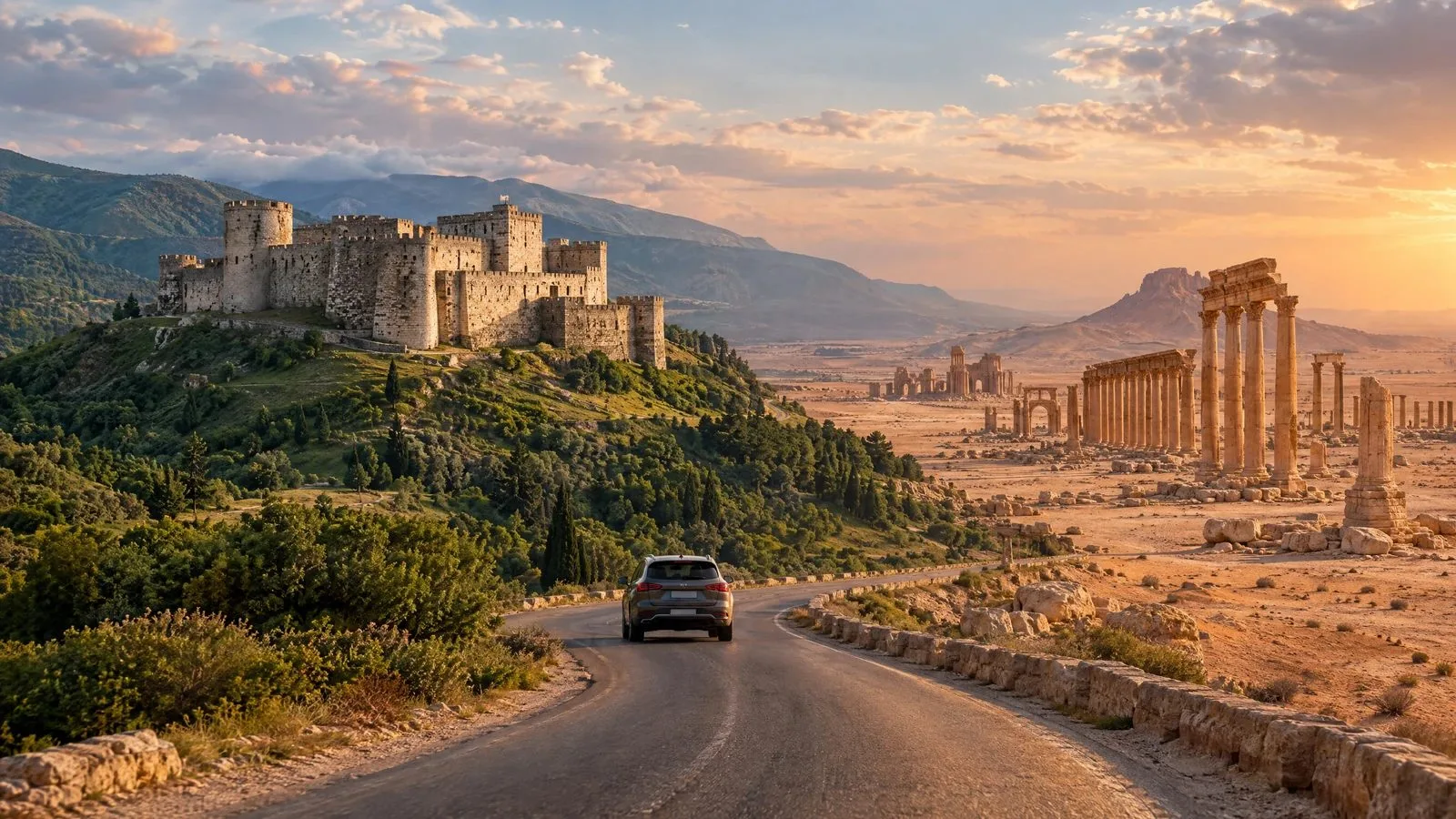
Homs is not usually the reason people come to Syria. It is the junction they pass through on the way to somewhere else — and that is exactly what makes it a good base. Almost nowhere else in the country puts a crusader castle one hour to the west and a desert oasis two hours to the east, with the highway north to Hama and Aleppo running straight through the middle of town.
If you have two or three days and a car, Homs is where you should sleep. Below is what each of the two great day trips involves: the distance, the road, the car that suits it, and the honest limits of what we can tell you before you go.
West: Krak des Chevaliers, about 65 km
The castle the Arabs call Qalaat al-Hosn stands above the village of al-Husn, roughly 65 km west of Homs. Allow about an hour of driving — closer to an hour and a quarter if you stop, and you will stop, because the castle appears on its ridge long before you reach it.
The route runs out of Homs on the Tartus road, then turns off and climbs south-west into the hills. This is the Homs Gap, the one wide break in the mountain chain that separates the Mediterranean coast from the Syrian interior. Every army that ever wanted to move between the sea and Damascus came through here, which is precisely why a fortress was built to watch it. Standing on the outer wall, the geography explains itself in a way no museum caption can.
The last stretch is a proper mountain road: narrow, winding, and climbing steadily. It is paved, but it is not a motorway. Take the bends slowly and expect to share the road with tractors and livestock.
Leave early. Setting off from Homs at eight in the morning gets you to the castle before the light goes flat, and leaves the whole afternoon free — the coast at Tartus is a reasonable onward drive from al-Husn, and plenty of visitors treat the castle as the first half of a day rather than the whole of it.
What we will not claim. Opening hours, ticket arrangements and which parts of the interior are accessible have all changed repeatedly since the war, and restoration work is ongoing. We would rather send you with a question than a wrong answer: ask locally, or at your hotel in Homs, on the morning you plan to go. What is certain is that the road there is fine and the drive is one of the best hours of tarmac in the country.
East: Palmyra, about 155 km
Palmyra — Tadmur — lies roughly 155 km east of Homs on a single desert highway. Two to two and a half hours each way is a fair estimate, depending on the state of the surface and how often you are stopped.
This drive could not be more different from the run to the castle. It is flat, straight and empty: steppe, then desert, with the horizon doing almost nothing for an hour at a stretch. It is easy driving and hard concentration. The oasis, when it finally shows up as a green line with palm trees and columns behind it, has the effect it has had on travellers for two thousand years.
Be prepared for what you will find. Palmyra suffered enormously between 2015 and 2017: the Temple of Bel, the Arch of Triumph, the Tetrapylon and several of the tower tombs were destroyed or gravely damaged, the museum was looted, and the modern town beside the ruins is largely wrecked. The colonnaded street, the theatre, the Valley of the Tombs and the citadel on the hill above still make the journey worth taking — but go to see what Palmyra is now, not the postcard from 2009.
Leave very early, and decide your return before you set off. Four to five hours of driving plus a serious site means a long day. Aim to be on the road out of Homs at first light and heading back with daylight still in hand; the desert highway is not a road to be learning in the dark.
Fill the tank in Homs. Our cars are handed over with a full tank and come back full, which suits this trip perfectly — top up on the way out of the city rather than counting on finding fuel in the middle of the steppe.
Which car for which road
The two trips ask for different things, and if you are doing both, choose for the harder one.
For Krak des Chevaliers, the climb matters more than the distance. A small car will get up there, but a car with a bit of engine behind it makes the last twenty minutes far more pleasant, and a slightly higher ride height is welcome on the rough patches near the village.
For Palmyra, distance and comfort matter more than power. You want a car that is quiet at highway speed, has working air conditioning you trust — the desert is brutal from June to September — and enough boot space for water, food and a spare layer for the evening.
Check the kilometre allowance before you book. Krak and back is about 130 km; Palmyra and back is well over 300. Two full days of touring from Homs adds up quickly, and every car on our site lists its own allowance on its page, so you can pick one that fits the itinerary instead of discovering the limit afterwards. There is no deposit to plan around either — none is taken on any of our cars, in cash, on a card or as a signed undertaking. You can rent a car in Homs directly from that page, and cancellation is free if the plan changes.
Making it a proper loop
There is a third option that most visitors miss. Hama is only about 47 km north of Homs on the M5 — half an hour — which means the norias, the old town and the Orontes fit into an afternoon on either end of your Homs stay. A sensible three-day shape: Krak on day one, Palmyra on day two, and a car in Hama and the waterwheels on day three before continuing north.
You do not have to come back to where you started, either. One-way rental is available, so a car picked up in Homs can be dropped in Aleppo, Latakia or Damascus at the end of the loop. If you are arriving from elsewhere first, we deliver free to Damascus Airport and within Damascus, and to Homs for a fixed fee — or see the full list of pickup points across our branches and delivery cities.
Drivers must be at least 23. We accept licences from every country, foreign licences included, and there is no nationality requirement — so if the Homs Gap is on your list, the paperwork is the easy part.