
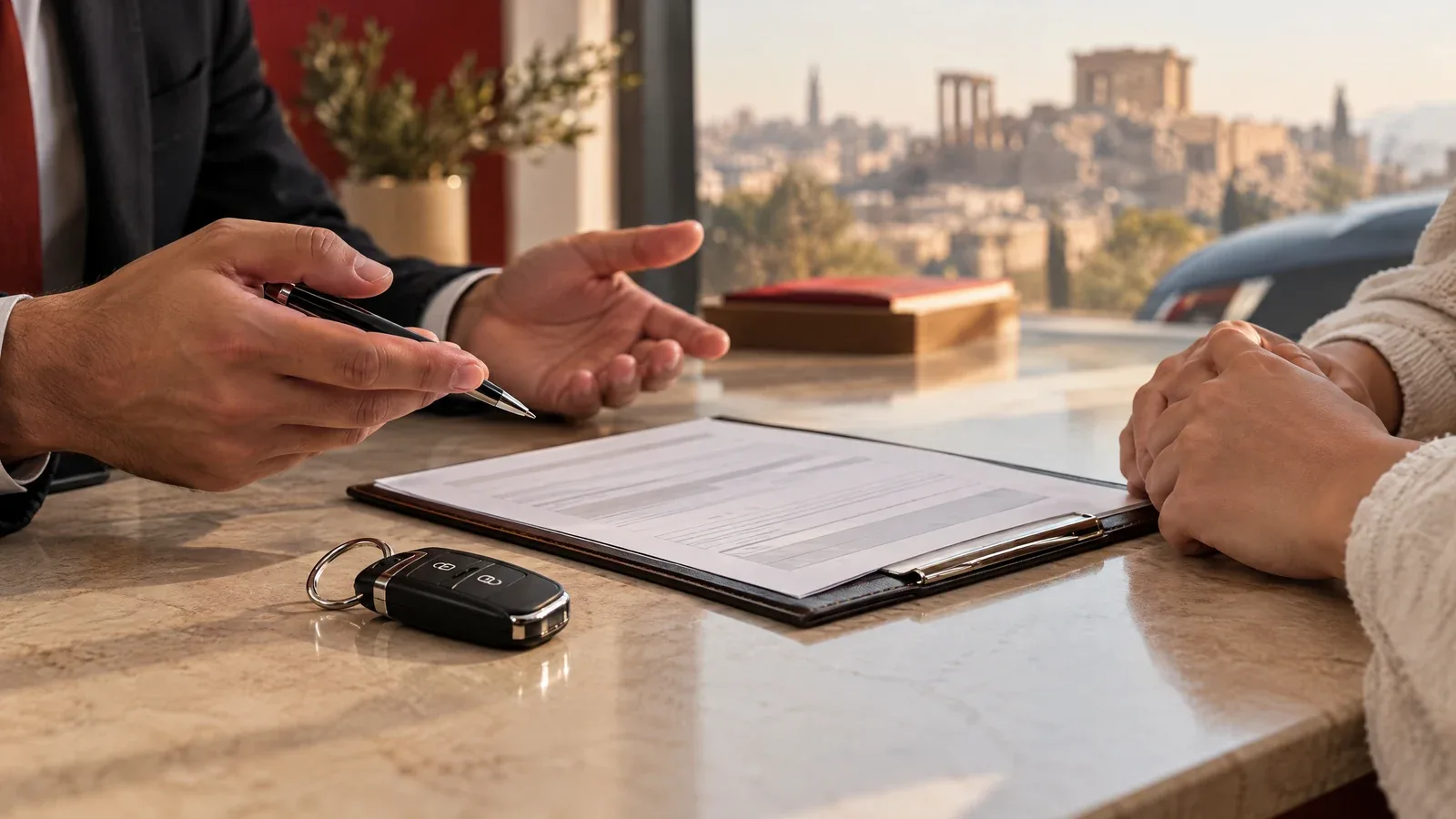
A deposit is not a price
The single most common confusion in car rental has nothing to do with cars. It is the gap between the rental price and the deposit.
The price is what the rental costs you. The deposit is what the company holds while the car is in your hands, and releases when the car comes back as it left. You are not spending the deposit. You are parking it.
That difference is easy to lose sight of when you are comparing offers in a market you don't rent in often. Two companies can quote the same daily rate and then ask for completely different things before the keys change hands — and it is that second requirement, not the rate, that decides whether the rental feels comfortable or awkward.
Why the habit grew here
In much of the world, deposits are almost invisible. The company takes a credit card, places an authorisation hold on it, and nobody thinks about it again until the hold drops off a statement weeks later. The whole arrangement rests on card infrastructure that does the trusting on the company's behalf.
Syria's rental market grew up without much of that infrastructure. Cars are expensive to replace, business runs largely in cash, and a company handing a vehicle to someone it met an hour ago needs the same reassurance any business anywhere needs. So the market improvised, using the ordinary instruments of a cash economy.
A visitor asking around Damascus will hear about several of them. Cash left with the office for the length of the rental. Signed papers held as security. A local guarantor — someone known in the area who signs alongside the renter. Documents proving where you live, sometimes down to a paper from the neighbourhood mukhtar. None of this is unusual by local standards; it is how a great deal of commerce is secured in the absence of card networks and credit records.
It is, however, genuinely hard on a visitor. Someone flying into Damascus for two weeks does not have a neighbourhood mukhtar, and may well not have a guarantor to call. This is exactly where a lot of rentals stall — not at the price, but at the paperwork behind it.
The forms a deposit takes
Whatever a company calls it, a deposit in this market usually takes one of three shapes.
Cash held. You leave an amount with the office at pickup and collect it at drop-off, after the car is checked. Straightforward, and the form most people picture when they hear the word.
A signed undertaking — sanad amaneh. This is a written instrument, well established in Syrian law and everyday commerce, in which you acknowledge responsibility for something entrusted to you. What matters for a renter is simple: you sign a paper, and no money leaves your pocket. The document is the security; it is settled and returned once the car is back.
A card hold. The familiar arrangement for anyone who has rented in Europe or the Gulf — an amount reserved on the card rather than charged, released after the rental closes.
Each of these secures the same thing in a different currency of trust. Which one suits you depends less on the rental company than on how you happen to be travelling.
How we handle it at Tab
Everything above describes a custom we no longer take part in. Tab does not take a deposit. Not on any car, not in any of the three forms.
That means, specifically: no cash held at the office, no card hold, and no sanad amaneh to sign. All three are ordinary here — most companies in this market take one of them, and a visitor is right to expect the question — so it is worth spelling out rather than leaving to be inferred from a blank field on a page.
What it changes in practice is the handover. You bring your driving licence and your passport or ID, we check them against the booking, you sign the rental agreement, and you take the keys. There is no second figure beyond the hire, nothing to count out at the counter, nothing frozen on a card that you then watch for on a statement after you have flown home, and no document held against you until the car comes back. When the hire ends you hand back the car with a full tank, and if nothing is outstanding that is the end of it.
It also removes the problem the section above describes. A returning Syrian arriving for two weeks has no neighbourhood mukhtar and often no local guarantor to call, and that — not the daily rate — is where a booking usually stalls. Here there is nothing to produce.
Three things are still asked of you, and they are the whole list: you must be 23 or over, you must hold a valid driving licence — issued in any country, with no nationality condition and no requirement to have held it for any length of time — and the car comes to you with a full tank and should go back with one. Beyond that: 200 km a day are included, extra kilometres are $0.10 each, cancellation is free, and two hours' grace is allowed on a late return before a further day is charged.
One thing a deposit is sometimes confused with, and should not be: insurance cover. They are different arrangements, and in Arabic they unhelpfully share a word. Cover is arranged per hire and the terms that apply to yours are confirmed on the rental agreement you sign at handover, so ask us what applies to the car and dates you have in mind before you book rather than afterwards. Not taking a deposit is not the same as there being no cover.
What to ask any company, including us
If you are comparing rentals in Syria, three questions will tell you most of what you need:
- What form does the deposit take — cash, a signed document, or a card hold?
- How much is it, for this specific car?
- When does it come back, and what has to be true for it to come back whole?
A company that can answer all three before you commit is one you can plan around. A company that answers them only at pickup is asking you to plan blind.
Ask us the same three and the answers are short: none, nothing, and there is nothing to come back. Ask the fourth question too — what is the cover and what would I be liable for — because that one we answer per hire rather than on a page.
A few other things are worth confirming in the same breath, because they are the ones that quietly change the shape of a trip: the minimum driving age is 23 with us, we accept driving licences from every country with no nationality condition and no holding period, fuel is handed over full and comes back full, and 200 km a day are included with extra kilometres at $0.10. Cancellation is free, which means you can hold a booking while the rest of your plans settle.
Where to start
If you know roughly what you want to drive, the clearest next step is simply to look at the cars. There is no deposit line to read on any of them, which is rather the point — what you see on a car's page is its daily rate, and that is what the hire costs.
Start with car rental in Damascus if you are picking up in the city, or browse the full range of pickup locations if you are arriving somewhere else, or planning to hand the car back in a different city from the one you collected it in — one-way rentals are available, and delivery is free at Damascus Airport and anywhere inside Damascus.