
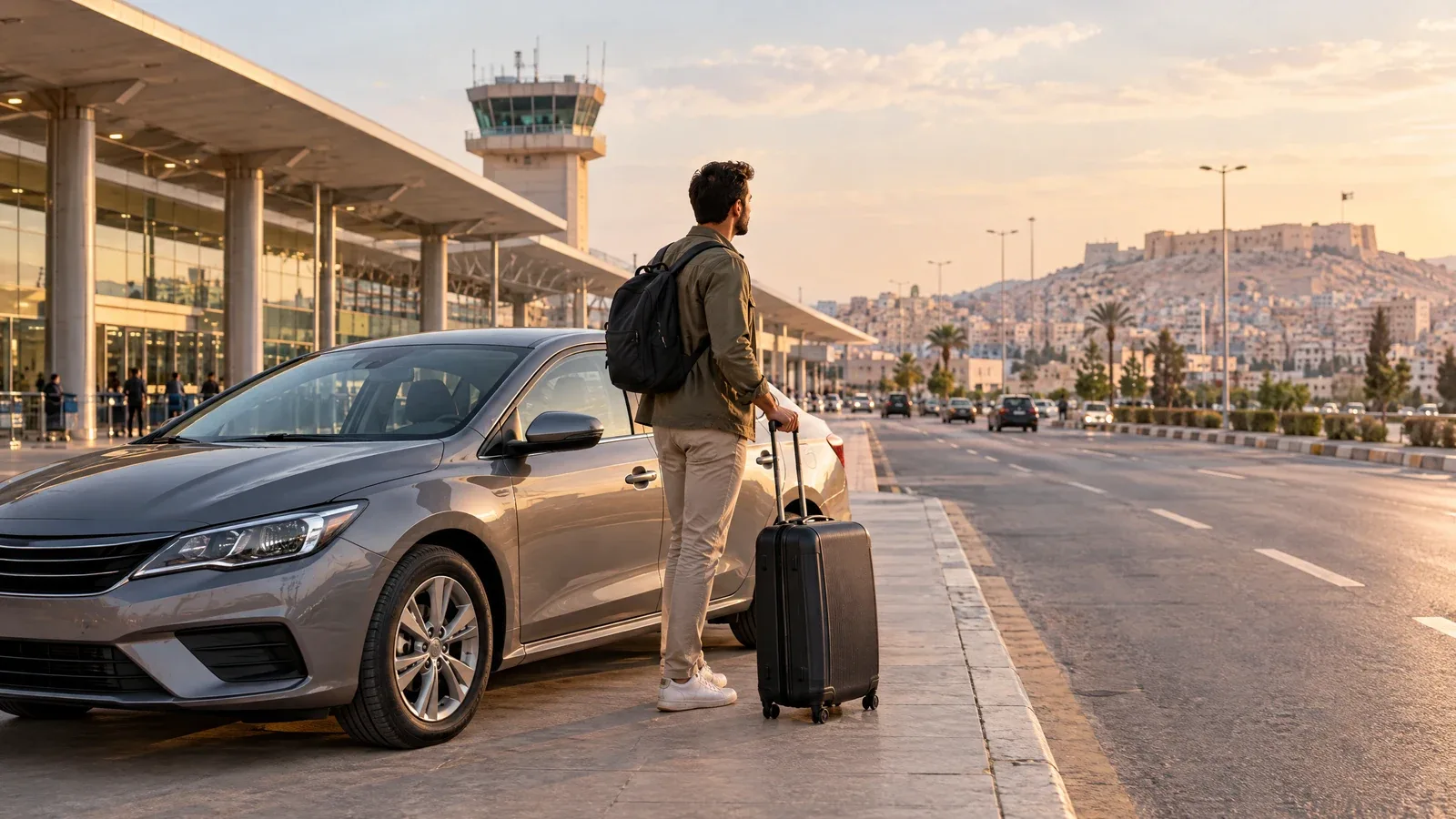
Aleppo International is a small airport, and small airports are pleasant to land at. Everything happens in one building, the distances inside it are short, and you are out again quickly.
What people underestimate about Aleppo is not the airport. It is how close the airport is, and how quickly you can be somewhere useful if the last stage of the journey was arranged before you took off.
Close enough to change the plan
The airport sits just outside Aleppo on the eastern side of the city, out beyond Nayrab — Aleppo International, ten kilometres east of the centre. That is a suburb-to-centre distance rather than a journey. Damascus airport is a proper drive — thirty kilometres or so of motorway before the capital even begins. Aleppo's is a hop: in ordinary traffic you are among buildings early and in the middle of the city not long after.
This has consequences worth planning around. A late arrival does not strand you an hour from your bed. You do not need to build a transfer into the evening. And a car meeting you at the terminal has not come from far away, which makes the timing easier to hold than it would be at a distant airport.
It also means the first driving you do is short, urban and slow — a gentler introduction than being handed keys and pointed at a motorway.
The car is driven up to meet you
Our only office is in Damascus, in Al-Mazraa. There is no desk of ours at Aleppo airport, and none in Aleppo either — the car is driven up to meet you. That is worth saying plainly rather than letting you discover it in the arrivals hall.
In practice this is not a drawback, and for most people it is better. A car brought out to you is a specific car, held for your date, at a price agreed before you flew, with its own terms written down. Arriving and asking what is left is a different experience, and rarely a cheaper one.
What it does mean is that the arrangement has to exist before you land. Book the car before the flight, and give us the flight number rather than a time typed into a form. A flight number is a live fact: it says whether the aircraft left late, whether it is early, whether it is now landing well after the schedule said. With it, we can work from the aeroplane rather than from the timetable.
Delivery to Aleppo airport is a flat fifty-five dollars, the same as delivery into Aleppo itself. The cars that can be brought out to meet you, each with its own terms on its own page, are listed on the car rental at Aleppo airport page.
Coming out of arrivals
The order is the same for everyone. Clear passport control, then collect your bags before you go looking for the car — walking out first and going back in for a suitcase wastes exactly the time a small airport saves you.
The paperwork afterwards is short and happens at the car: your driving licence, your passport and a signature. There is no deposit to arrange, on this car or any other. Keep the licence and passport reachable rather than at the bottom of a bag and it takes a few minutes. We accept licences from every country, so a foreign one is no obstacle — bring the physical card, not a photograph of it.
The drive in
Aleppo announces itself early. The buildings close in, the roads fill, and the city thickens around you rather than arriving all at once. Traffic behaves the way it does in most large Levantine cities: assertive rather than aggressive, lane markings treated as suggestions, the horn used to say "I am here" rather than to complain. Drive predictably, leave a slightly larger gap than you would at home, and commit to your gaps rather than hesitating in them: hesitation causes more trouble here than a firm, well-signalled move.
Two habits help. Know the name of the neighbourhood you are going to, not just the street; it is far more useful than an address when you ask directions. And use the citadel as your compass — it stands on its mound above the old city and is visible from much of the centre, which tells you roughly where you are faster than a map read at a junction.
Where the car stops being useful
Aleppo rewards a car right up to the edge of the old city, and then it stops, in the best possible way. The covered souks and the lanes below the citadel are not places you drive; they are places you park near and walk into. The souks are a roofed stone labyrinth, dim and cooler than the street outside, with no width in them for a car. Jdeideh, north of the old city, is the same on a smaller scale: courtyard houses and narrow stone lanes, a quarter built for feet.
So a day in Aleppo tends to go: drive to the edge, park, walk for hours, come back to the car. What the car really buys you is everything else: the outer neighbourhoods, an evening across town, the freedom to leave on an hour's notice. If you are working out how long Aleppo is worth and what to do with the car while you are there, the car rental in Aleppo page covers delivery to an address in the city, what it costs, and which cars can be sent up.
If Aleppo is the beginning rather than the end
A good many people fly into Aleppo and do not stay in it. The city sits at the northern end of the country's main trunk route, so Hama and Homs are a straightforward run south, and the coast is reached by turning west near Homs. The driving is much of the pleasure.
Two things make that easier. One-way rental is possible: collect in Aleppo and hand the car back in another city, so you are not obliged to retrace a long route simply to return it — say so when you book. And the fleet is small and current — all 2025 or 2026 cars — so the choice is quick. A Kia K3 saloon suits one or two people and city driving. A Hyundai Creta or Kia Sportage gives you higher ground clearance for village roads and mountain switchbacks. The seven-seat Kia Sorento is the one to book if you are arriving as a family, or collecting relatives once you are here.
The short version
Aleppo International is small, close to the city, and easy to arrive at. Book the car before you fly and give us the flight number — it matters more, not less, when the car is driven up from Damascus to meet you rather than waiting at a terminal desk. Collect your bags before you look for the car. Expect a short urban drive rather than a motorway run. Park at the edge of the old city and walk. And read the terms on the car's own page before you book, not when the keys are in your hand.